The crown was a leaden weight upon his brow. King Leonardo sat at the head of the vast council table, his storm-grey eyes seeing not the maps and scrolls before him, but the ghost of a different life.
Ten years. A decade of conquest, of prosperity, of unwavering duty. Yet the hollow ache in his chest had only carved itself deeper with each passing season.
“Your Majesty.” The voice of Chancellor Marcus cut through the fog of his grief. “Queen Isidora’s request for a larger household guard requires your approval.”
Leonardo forced his gaze to his wife. She sat perfectly poised, her beauty as cold and polished as the marble throne she occupied. Their union had been a masterstroke of politics, uniting two powerful kingdoms. It had given him everything a king could desire, save for the one thing he had sacrificed to obtain it.
“Granted,” Leonardo said, the word curt and hollow.
A thin, bloodless smile touched Isidora’s lips. It never reached her eyes. She was the perfect queen, as flawless and lifeless as a statue. Their marriage was a transaction, a union of power, devoid of the warmth, the laughter, the shared vulnerability that made the burden of a crown bearable.
As his advisers droned on about grain yields and tax revenues, Leonardo’s mind drifted to sun-drenched meadows and the scent of wildflowers. To her. Arabella. She would have rejoiced at the news of a bountiful harvest, finding joy in the simple, honest prosperity of his people.
“Is there nothing else?” he interrupted, the words sharper than intended. The sudden silence in the chamber was heavy with surprise. He was never the first to dismiss them.
“Nothing that cannot wait until morning, Your Majesty,” Marcus replied, his tone carefully neutral.
Leonardo rose, the scrape of his chair echoing in the stunned quiet. He fled the council chamber, the gilded corridors of his castle feeling more like a gilded cage with every step.
A timid servant intercepted him, flinching under his gaze. “Your Majesty… Master Edwin requests your instruction. The old storage chambers in the East Tower… they hold… personal effects. From before.”
The East Tower. A place sealed by his own command, a tomb for the man he used to be.
“Tell him to wait,” Leonardo heard himself say, a part of his soul he thought long dead stirring to life. “I will see to it myself.”
The key to the tower was cold and heavy in his palm. The air inside was thick with dust and memories. And there, on a simple wooden desk, sat a familiar leather-bound box.
Arabella’s box.
His hands trembled as he lifted the lid. The scent of dried lavender—her scent—rose to meet him, a ghost from a past he had tried to bury.
Inside, he found not just pressed flowers and faded sketches, but a stack of letters, tied with a ribbon, in her delicate, looping script. Letters he had never seen.
My beloved Leo, the first began. I know I can never send these words to you…
He fell into the dusty chair, his kingly composure shattered. He read of her love, her understanding, her silent, steadfast grief. “A man who could abandon his people for love would not be the man I fell in love with,” one letter said, the nobility of her spirit a blade to his heart. “But oh, my darling, how I wish there had been another way.”
Tears, the first he had shed in a decade, blurred the words on the page.
“So,” a voice, cold as ice, sliced through the room. “This is where you nurse your… sentimentalities.”
Queen Isidora stood in the doorway, her pale eyes taking in the scene—the disgraced king, the scattered letters, the evidence of a heart that had never been hers.
“Ten years as your queen,” she said, stepping forward with a predator’s grace. “And you still grovel in the dust for a dead peasant.”
“Do not speak of her,” Leonardo snarled, rising to his full height, a protective fury blazing through him.
Isidora’s laugh was the sound of shattering glass. “Truth wounds, does it not? While I have borne the weight of your crown, you have cherished the scribblings of a girl who warmed your bed.”
The words hung between them, a declaration of war.
“She was worth a thousand of you,” Leonardo said, the truth quiet and devastating.
Isidora’s mask of composure cracked, revealing the venom beneath. “We shall see. A king clinging to ghosts has no grip on his throne. Perhaps the council should know of your… weaknesses.”
She swept from the room, leaving him alone with his shattered peace and a terrible certainty: his moment of weakness would have consequences.
Clutching the letters to his chest, he made a decision. He would go to her. To Arabella’s grave. He would finally say the goodbye duty had stolen from him.
He had no idea that fate was waiting there, ready to shatter his world completely.
The common cemetery was a humble, peaceful place, a world away from the cold splendor of the royal crypts. Mist clung to the wildflowers as he walked among the headstones, his heart pounding a frantic rhythm against his ribs.
And then he found it. A simple, modest stone.
Arabella Morrow. Beloved Mother. Forever in our hearts.
Beloved Mother.
The words were a physical blow. She had moved on. Found love, a family, a life without him. A pain, sharp and jealous, lanced through his grief.
It was then he heard it—the sound of crying. Small, heartbroken sobs that called to something primal within him.
He followed the sound around a copse of trees.
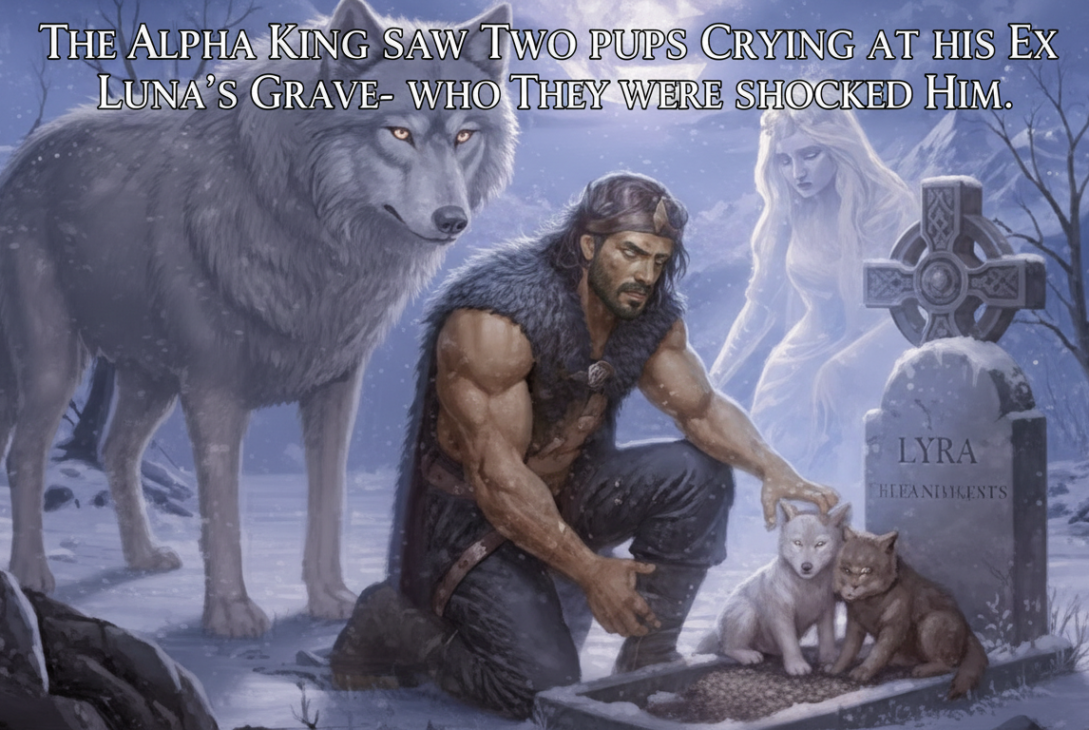
Two children knelt before the grave. A boy and a girl, no older than five, their small forms wracked with grief. They had hair the color of sunlight.
The little girl looked up as he approached.
And the world stopped.
Storm-grey eyes, the exact mirror of his own, set in a face that was a perfect blend of his strong features and Arabella’s delicate beauty, stared back at him. The air carried the unmistakable, undeniable scent of his own royal bloodline.
These were not another man’s children.
They were his.
“Papa?” the little girl whispered, the word a fragile, heartbreaking question.
The boy immediately stepped in front of his sister, a tiny, fierce protector despite the tears on his cheeks. “You’re not supposed to be here,” he said, his voice trembling but brave. “Mama said you could never come back.”
Leonardo fell to his knees before them. The ground seemed to fall away beneath him. The truth crashed over him with the force of a tidal wave, drowning a decade of regret in a single, devastating instant.
He hadn’t just lost the love of his life.
He had lost his children.
Staring into the eyes of his son and daughter, the King, who had sacrificed everything for his crown, finally understood the true, horrifying cost of his duty.
innocent vulnerability it shattered the last of his composure.
“Mama showed us pictures,” she whispered, her voice a tiny, trembling bell in the vast silence of the graveyard. “She said you were our papa, but you had to go away to be king. She said you loved us… but you couldn’t stay.”
Each word was not an arrow, but a hammer blow to Leonardo’s soul. Arabella. Even in her solitude, even in her heartbreak, she had not poisoned his memory. She had built him a shrine in their children’s hearts—a loving, absent king, a father constrained by duty. Her selfless love, a stark, blinding contrast to his decade of ignorant sorrow, made him feel less than the dirt beneath his knees.
“What are your names?” he managed to ask, his voice rough with an emotion too vast to name.
“I’m Valentina,” the girl said, with the pure, unguarded honesty of a child who has not yet learned to lie. She gestured to her brother, who stood like a tiny, fierce sentinel. “This is my brother, Valentino. We’re twins. Mama said we came together because we didn’t want to be apart. Ever.”
Valentino’s protective stance had not relaxed an inch. His young face, a perfect blend of Leonardo’s own jawline and Arabella’s gentle eyes, was etched with a wisdom no child should possess.
“Why are you here now?” the boy challenged, his voice trembling with a grief too large for his small frame. “Mama said you couldn’t come back. She said being king was too important.”
The accusation was a shard of ice plunged directly into Leonardo’s heart. He looked from Valentino’s wounded, suspicious gaze to Valentina’s hopeful, tear-filled one, and saw the living, breathing consequences of a choice made in a different lifetime.
“I didn’t know about you,” Leonardo confessed, the words feeling desperately inadequate. “I swear to you both, on my crown and my life, I didn’t know your mama was going to have babies.”
Valentina’s small hand reached out, barely brushing the rich fabric of his cloak. “If you had known,” she asked, her voice a whisper of devastating, childish logic, “would you have stayed?”
Leonardo’s breath caught. His mouth opened, then closed. The noble lie, the kingly platitude, died on his tongue. The brutal, honest answer—that duty, the very chains that had strangled his happiness, might still have won—would extinguish the fragile light in his daughter’s eyes forever.
“I don’t know,” he admitted, the truth a painful, necessary offering. “But I wish, with everything I am, that I had been given the choice.”
Before the children could process his heartbreaking honesty, a shadow fell over them. An elderly woman emerged from behind a nearby monument, her movements slow and aided by a gnarled walking stick. Her kindly, weathered face showed surprise at the nobleman kneeling in the dirt.
“Valentina, Valentino,” she called gently, her voice raspy with age. “Come away now, my doves. You mustn’t bother the fine lord.”
But as she drew closer, her steps faltered. Her eyes, clouded with years, widened in dawning horror and recognition. Leonardo watched the blood drain from her face as she realized exactly who was kneeling before his children.
“Your Majesty,” she breathed, the title a terrified whisper. She dropped into an awkward, painful cursey, her aged joints protesting the sudden movement.
“You know who I am,” Leonardo stated, rising to his full, imposing height, the King reasserting himself in the space.
“I am Elena, Your Majesty,” she stammered, unable to meet his gaze. “I was… I was Arabella’s neighbor. I’ve been… caring for the little ones since she…” Her voice broke, the sentence too heavy to finish.
“How long?” Leonardo asked, the question a blade he had to turn on himself.
“Six months, Your Majesty.” Elena’s eyes filled with tears of shared grief. “The fever took her quick, but she suffered much before the end.” The old woman’s voice dropped to a haunted whisper. “She called for you. Near the last.”
Leonardo felt something vital fracture in his chest. A soundless, internal scream. She called for me. Arabella had died with his name on her lips, believing him lost to duty, never knowing he would have burned his entire kingdom to ash for one more moment with her.
“And she made me promise,” Elena continued, her voice gaining a thread of steel, “to tell the children you loved them. Even if you could never come home.”
The finality of it was a tomb sealing shut. His children, his beautiful, lost children, stood before him—the living embodiment of his most profound failure and his only chance at redemption. The question now screamed in the silence of his soul: What would a king, who had sacrificed everything for his crown, do when that crown was the very barrier to his heart?
Elena’s modest cottage was a world of simple, honest poverty. The thatched roof, the carefully tended flower boxes, the scent of woodsmoke and drying herbs—it was a life of humble comfort that filled Leonardo with a king’s profound, gut-wrenching shame.
The old woman moved about her small kitchen, preparing a simple stew while Valentina and Valentino sat at a scarred wooden table, their eyes never leaving the father who was a ghost made flesh.
“Tell me about their mother,” Leonardo asked, his voice low as he settled into a chair that groaned under his weight. “Tell me about their life here.”
Elena’s weathered hands stilled. “Miss Arabella was the finest woman I ever knew, Your Majesty,” she began, her voice thick with memory. “When she came here, heavy with child and no ring on her finger, this village could have cast her out. But she had healing hands. She could birth babies and mend fevers like she was born to it. She made herself indispensable, real quick.”
Valentina looked up from a worn wooden horse. “Mama helped people. When Mrs. Catherine’s baby was stuck, Mama made him come out safe.”
“When the fever came last winter,” Valentino added, his defensive posture softening slightly as he spoke of his mother’s strength, “Mama made medicine from pine bark and willow. She taught us which herbs help with pain. She said helping people was the most important thing we could do.”
Of course. Of course, she had become a healer. Even in exile, even in poverty, Arabella’s innate compassion had been her compass. She had not just survived; she had served. The nobility of her spirit made his royal lineage feel like a tawdry, meaningless trinket.
“She never spoke ill of you, Your Majesty,” Elena said, placing bowls of simple stew before the children. “Even when the fever was burning through her, even when she was terrified of what would become of these two… she said you were a good man caught in a hard situation.”
The forgiveness in those words was a crown of thorns. For ten years, he had worn his sacrifice as a badge of honor. Now, her understanding revealed it as the hollow, selfish act it had been.
“What happens to them now?” Leonardo asked, his gaze fixed on Valentina as she carefully broke her bread to share with her brother. “How are they cared for?”
Elena’s face clouded with a worry too deep for words. “I do my best, Your Majesty, but I’m old. My hands don’t work like they used to. The village helps when they can, but times are hard for everyone. The children… they need more than I can provide.”
“They need a father,” Valentino said suddenly, his young voice carrying the weight of a universal truth. “But Mama said kings can’t be papas. They have to choose their kingdoms instead.”
The words landed with the force of a physical blow. His five-year-old son had already accepted a life of abandonment, already understood that his father’s title was a sentence of exile.
“What if that wasn’t true?” Leonardo asked, his voice dangerously soft. “What if a king could choose to be a papa, too?”
The hope that blossomed on their small faces was so bright, so pure, it was almost painful to behold. But it was Elena’s expression—a silent, terrified warning—that reminded him of the cataclysm he was inviting.
“Your Majesty,” she said, her voice barely a whisper. “These children love you already, just from their mama’s stories. Don’t… don’t give them hope you can’t honor.”
Leonardo looked from the old woman’s desperate plea to his children’s expectant faces. He felt the weight of two worlds on his shoulders—the gilded cage of his crown and the humble, sacred trust of their small, outstretched hands.
His own hands trembled as he reached out, enveloping Valentina’s tiny fingers in his. Her trust was a more sacred vow than any coronation oath.
“Pack whatever you need,” he said, his voice quiet, but absolute, the decision etching itself into his very bones. “You’re coming home with me.”
The ride back to the castle was a journey through Leonardo’s own crumbling defenses. Valentina sat before him on his massive warhorse, her small body trusting and warm against his chest, chattering with the fearless wonder of a child meeting her destiny.
“Is your castle very big?” she asked, twisting to look up at him, her storm-grey eyes wide. “Mama said it had towers that touched the clouds and rooms full of treasure.”
“It’s big,” Leonardo confirmed, his heart aching at her innocence. “But most of the rooms are empty. And the treasure… it’s mostly old books and dusty armor.”
“I like books,” Valentino called from where he rode with Elena on a gentle mare, his serious eyes missing nothing. “Mama taught us to read. She said knowledge was the one treasure no one could ever steal from you.”
Another layer of his heart peeled away. Arabella had armed them not with swords, but with wisdom. She had prepared them for a world that would see them as stains on a royal legacy.
When the castle walls finally rose into view, Leonardo saw them not as a symbol of his power, but as a fortress he was about to storm from within. The guards at the gate recognized their king, but their disciplined masks slipped at the sight of his companions—a ragged old woman and two peasant children who bore a startling, unnerving resemblance to the man they served.
“Remember,” Leonardo murmured to a trembling Elena as they dismounted in the main courtyard, “they are under my personal protection. Anyone who questions their presence answers to me.”
Before Elena could nod her understanding, Chancellor Marcus appeared, his face a masterclass in suppressed alarm.
“Your Majesty,” he began, his tone carefully neutral, his eyes darting to the children. “We were not expecting your return. Shall I prepare… chambers for your… guests?”
The pause was a verdict in itself.
“Prepare chambers in the family wing,” Leonardo commanded, his voice cutting through the courtly silence. “These children will be staying. Permanently.”
Marcus’s composure cracked. “Your Majesty, perhaps we should—”
“There is nothing to discuss,” Leonardo interrupted, his voice dropping to a low, dangerous register that brooked no argument. He turned, making sure his voice carried to every guard, every servant, every lurking courtier in the courtyard.
“Valentina and Valentino are my children,” he declared, the words ringing off the ancient stones. “They are of my blood. And they will be treated with all the respect their royal lineage demands.”
The silence that followed was profound, a vacuum of sound before the coming storm. And as if summoned by the tremors of his declaration, she appeared.
Queen Isidora stood on the grand steps of the great hall, a vision of cold perfection. Her pale gaze swept the scene, from the trembling old woman to the dusty, wide-eyed children, and finally, to the king who defied her. The moment her eyes locked onto the twins, Leonardo saw the exact instant understanding dawned—and with it, a fury so absolute it seemed to freeze the very air.
The reckoning he had dreaded was here, standing before him in silk and cold fury. But as Valentina’s small, trusting hand slipped into his, as he saw Valentino’s brave attempt to stand tall despite the overwhelming grandeur and hostility, Leonardo knew, with a certainty that shook his very soul, that he had made the only choice he could live with. For the first time in a decade, the King had chosen love over duty. Let the consequences rain down like fire.
The private dining chamber had never felt more like a executioner’s block. Queen Isidora sat at the far end of the impossibly long table, a statue of ice and malice, her pale eyes cataloging every flaw, every sign of humble origin in the two children who dared to share her space.
Leonardo had insisted the children join them, a desperate attempt to present a united front. But the air crackled with a tension so thick it was a miracle the fine china didn’t shatter. Valentina and Valentino sat on either side of him, their simple, homespun clothes a stark, defiant splash of reality against the oppressive opulence. They ate with careful, remembered manners, their small movements a testament to a mother who had taught them grace even in poverty.
“So,” Isidora’s voice sliced through the silence, sharp and surgical. “These are the bastards you’ve decided to inflict upon our court.”
Leonardo’s knuckles turned white around his silver goblet. But before his rage could find voice, Valentino looked up, his clear, serious eyes meeting the Queen’s glacial stare without flinching.
“We’re not bastards,” the boy stated, his voice quiet but unyielding. “Mama said we were children of love. She said that makes us precious, even if the world calls us something else.”
The simple, dignified correction, delivered with the unwavering faith of a child, was a more powerful blow than any insult. Isidora’s lips pursed into a bloodless line, humiliated by the truth from a five-year-old. Leonardo felt a surge of fierce, blazing pride.
“How charming,” Isidora replied, her voice dripping with poisoned honey. “I suppose your mother filled your heads with many such… romantic notions about your… situation.”
“Our mama was wonderful!” Valentina burst out, her loyalty overriding her fear, though her lower lip trembled. “She helped people! And she made the best honey cakes! And she sang to us every night!”
“I’m sure she was… very talented.” Isidora’s tone twisted the word into something vulgar. “Though one wonders what other talents she possessed to capture a king’s attention so… thoroughly.”
Leonardo slammed his goblet down. The crash echoed like a gunshot, making the children jump.
“That. Is. Enough.” His voice was low, a king’s whisper that promised violence. “You will not speak of Arabella with disrespect. Not in front of me. Not ever. But especially not in front of her children.”
“Her children?” Isidora’s laugh was the sound of shattering crystal. “I think you mean your bastards. Let’s not dress this sordid little affair in pretty words, husband. You’ve dragged your illegitimate offspring into our home and expect me to welcome them as family?”
The children had gone still, two small statues of fear and confusion. Valentina’s eyes were wide pools of hurt, while Valentino’s jaw was set, a tiny soldier bracing for a war he didn’t understand.
“They are my children,” Leonardo declared, each word a stone laid in a new foundation. “And as such, they will be treated with the respect due to royal blood. I suggest you accustom yourself to their presence. They are not leaving.”
Isidora rose slowly, a serpent uncoiling. Her pale gaze swept over them, and the calculation in her eyes was colder than any winter.
“You think you can simply waltz back here with your dead mistress’s spawn and disrupt the careful order we’ve built?” she hissed, her composure finally cracking to reveal the raw fury beneath. “You think I will stand by while you parade your infidelity before the entire court?”
“I think,” Leonardo replied, his voice dropping to a deadly calm, “that you will remember your place. And you will accept that my children are now part of this family, whether you approve or not.”
The Queen’s smile was a thin, cruel slash.
“We shall see about that,” she whispered, the promise a venomous curse. “The court will have so much to say about their king’s sudden display of… sentimentality. I wonder how long your resolve will last when the political consequences of harboring bastards begin to crumble your precious throne.”
She swept from the room, leaving a silence that felt like the aftermath of a bomb. Valentina looked up at Leonardo, her small face etched with worry.
“Did we make the scary lady angry?” she asked in a tiny, trembling voice.
Leonardo pulled her onto his lap, gathering a stoic Valentino close against his side. He could feel the boy’s heart hammering against his ribs.
“The scary lady was already angry,” he murmured into Valentina’s hair, holding them both as if he could shield them from the world. “But you listen to me. You do not need to worry about her. Your Papa will keep you safe. Always.”
As he held his children, their trust a tangible, warming light in the cold room, Leonardo knew Isidora’s threats were not empty. She was a master of politics, of influence, of quiet, brutal sabotage.
But looking down at Valentina’s golden head nestled against his chest, and meeting Valentino’s fiercely protective gaze, he found a courage he never knew he possessed.
Let the court whisper. Let the nobles plot. Let the very foundations of his kingdom tremble.
These children were his. And he would protect them with every breath in his body, even if it meant burning his crown to ash.
Three days had passed, and the castle was a cauldron of simmering gossip. Servants whispered behind raised hands, nobles exchanged glances laden with meaning, and the children found themselves the subject of relentless, curious stares.
Yet, with the remarkable resilience of the young, Valentina and Valentino were adapting. Leonardo had installed them in chambers adjoining his own, a blatant defiance of protocol and his wife’s icy wrath.
“Papa, look!” Valentina cried out as he entered their solar one morning. She was pressed against the tall window, her small hands splayed on the cold glass. “They’re dancing with their swords down there!”
In the training yard below, knights practiced their drills.
Valentino let out a long-suffering sigh, the wisdom of his extra minutes of life evident. “That’s not dancing, Valentina. They’re fighting. Practicing for battles and… stuff.”
“I know that,” she protested, though her cheeks flushed. “But it looks like dancing. All graceful and spinny.”
Leonardo felt a genuine smile, the first in years that reached his eyes, break across his face. Their wonder was a tonic, making him see the cold stone and ritual of his home as something new and magical.
“Would you like to see it closer?” he asked, joining them at the window.
“Could we?” Valentina breathed, her eyes wide with excitement.
“I don’t know,” Valentino said, his natural caution surfacing. “Are we allowed? We don’t want to cause trouble.”
The question was a tiny dagger to Leonardo’s heart. They were already learning to shrink, to apologize for their own existence.
He knelt, bringing himself to their level, his hands on their small shoulders.
“Listen to me,” he said, his voice firm and clear. “You are my children. This is your home. You can go anywhere you wish, as long as you tell me or Elena where you are going.”
“Even the throne room?” Valentina asked, with breathless daring.
“Even the throne room,” he confirmed, a grin tugging at his lips. “Though I warn you, it is terribly boring. Nothing but old men talking about taxes and turnip yields.”
A soft knock interrupted their laughter. Elena entered, her arms full of new clothes, her face still etched with the awe of her new position.
“Begging your pardon, Your Majesty,” she said, bobbing a curtsy. “But Lord Marcus is asking for you. Something about… arrangements for the young ones.”
Leonardo’s jaw tightened. He knew what “arrangements” meant.
“Can we come with you?” Valentino asked, his small hand slipping into Leonardo’s with a trust that felt like both a gift and a burden.
The request was innocent, but its implications were monumental. To bring them into the council chamber was to declare war on tradition, to force every noble to acknowledge their place not as dirty secrets, but as heirs to his heart.
He looked at their hopeful, uncertain faces.
“Yes,” he said, the decision settling into his bones with the weight of destiny. “You will come with me. It is time everyone met you properly.”
As they walked the long corridors toward the council chamber, a hush fell in their wake, followed by a wave of frantic whispers. Valentina held his hand tightly, while Valentino walked on her other side, a miniature guard. Leonardo felt the weight of their future pressing down on him.
The transformation he had avoided for ten years was here. The King was ready to fight. And he was taking his children to the front lines.
The council chamber fell into a dead, stunned silence the moment Leonardo entered with his children. The air grew thick with unspoken judgment and political alarm. The assembled lords, men who had served his bloodline for generations, stared openly at the living, breathing proof of their king’s greatest scandal.
Lord Marcus stood, his face a mask of strained neutrality. “Your Majesty. A word, if we may, about the recent… developments in your household.”
“Of course,” Leonardo replied smoothly, taking his seat and lifting Valentina onto his lap. Valentino stood straight and proud beside his chair. “But you should know, my children will be attending these meetings from now on. They are, after all, part of this family.”
The statement landed like a declaration of war. Alarmed glances were exchanged across the table.
“Your Majesty,” Lord Aldrich began, choosing his words as if walking on broken glass. “While we understand your… paternal feelings… the presence of… illegitimate children at court raises certain… questions. About succession. About stability.”
“What questions?” Leonardo asked, his tone deceptively mild.
Marcus stepped in, the diplomat. “The legitimacy of the royal line is the bedrock of our kingdom’s stability, sire. The presence of acknowledged… natural-born children… while not without precedent… can create… complications.”
Valentino looked up, his brow furrowed in confusion. “Papa? What’s a ‘bastard’? They keep using that word. But Mama said it was a mean name for people.”
The innocent question hung in the air, exposing the ugly heart of their political maneuvering. These lords were discussing his children as if they were a pestilence, not people.
Leonardo looked down at his son, his voice clear and carrying, meant for every ear in the room.
“A bastard,” he said, the word losing its power in his calm delivery, “is what small-minded people call children born outside of marriage. As if the circumstances of their birth could ever diminish their worth, or their courage, or their capacity for greatness.”
“Your Majesty,” Lord Garrett spluttered, his face flushing red. “Surely you see the delicacy! Queen Isidora has… concerns. This affects your marriage! Your reputation!”
“My reputation?” Leonardo’s voice dropped to a whisper that was more terrifying than a shout. “Are you suggesting that acknowledging my own flesh and blood damages my reputation?”
The silence was absolute.
Marcus, ever the pragmatist, tried one last time. “Sire… perhaps the children would be more comfortable… elsewhere. A noble family in the country. They could be educated, cared for… away from the… complications… of court life.”
He felt Valentina’s small body tense against him. He saw Valentino’s face fall, the understanding dawning that these men in their fine clothes wanted to send him away.
“You…” Valentino’s voice was small, but it cut through the room. “You want to send us away? Just like Mama said you would.”
The quiet devastation in those words, the resigned acceptance of a rejection he had always been taught to expect, was the final straw. Here was a child showing more grace than the entire council combined.
Leonardo rose to his full height, his daughter in his arms, his son at his side. He was no longer just their king. He was their father.
“No one,” he vowed, his voice echoing with a finality that brooked no argument, “is sending you anywhere. You are home. This I swear.”
“This is your home,” Leonardo’s voice rang out, final as a judge’s gavel, “and here you will stay.”
“But Your Majesty—” Lord Aldrich began, his voice strained with the weight of political consequence.
Leonardo cut him off, his gaze sweeping the council chamber, silencing the old lord with its intensity. “My children are not political problems to be solved. They are not inconveniences to be hidden away in the countryside. They are part of this family.” He leaned forward, his palms flat on the polished table. “And anyone in this room who cannot accept that reality is welcome to tender their resignation. Immediately.”
The threat did not just hang in the air; it solidified, becoming a blade pressed against every throat. These men had built their legacies on royal favor. The prospect of losing it was a fate worse than any battlefield death.
But as Leonardo looked from one calculated expression to the next, he saw not acceptance, but merely a temporary, fearful retreat. The opposition had not vanished. It had simply slunk back into the shadows, waiting for a stronger hand to guide it. And he knew, with a cold, sinking certainty, exactly whose hand that was.
That evening, in the quiet sanctuary of his private study, Leonardo faced a battle more daunting than any council dispute: explaining the cruel complexities of adult politics to two five-year-olds.
“Papa,” Valentina’s small voice was muffled against his doublet, her tiny form curled trustingly against his side. “Why don’t the lords like us?”
The question, so pure and direct, was a lance through the heart of a lifetime of courtly deception.
Leonardo chose his words with more care than he had ever used in any treaty negotiation. “It’s not that they don’t like you, my star. They are… afraid.”
“Afraid of us?” Valentino looked up from his wooden soldiers, his brow furrowed in genuine confusion. “But we’re small. We’re not scary.”
“They are afraid of change,” Leonardo explained, his voice a low, gentle rumble. “The lords are used to a world that is ordered and predictable. Your presence here… your wonderful, brilliant presence… means that world must change. And some people fear different things, even when ‘different’ is the most beautiful thing to ever happen to them.”
Valentina twisted to look at him, her mother’s clear blue eyes searching his face. “Are we making trouble for you, Papa?” she whispered, the words laced with a heartbreaking anxiety. “Is the scary queen lady angry… because of us?”
The perceptiveness of it stole his breath. They were internalizing the blame, learning to see their own existence as a burden. The realization filled him with a protective fury so vast it threatened to consume him.
He gathered them both close, his arms a fortress around them.
“Listen to me,” he said, his voice thick with emotion. “You are not trouble. You are not a problem. You are the greatest joy of my life. Having you here has filled a hollow in my soul that I thought would be empty forever.”
“But the Queen Lady,” Valentino stated with his unflinching honesty, “she looks at us like we’re… like we’re a bad smell.”
Leonardo’s heart clenched. “Queen Isidora is… complicated. She married me for reasons of power and politics. And seeing you… seeing the living proof of a love that had nothing to do with those things… it reminds her of a truth she would rather forget.”
“Did you love our mama,” Valentina asked, her voice small but clear, “more than the queen?”
The question, innocent and devastating, hung between them, challenging the very foundation of his reign.
He did not hesitate.
“Yes,” he confessed, the truth feeling like both a sin and a sacrament. “I loved your mother more than duty, more than my crown, more than my own life. She was sunlight. She was laughter. She was everything good and true in this world.”
“Then why,” Valentino pressed, his child’s logic inescapable, “didn’t you marry her?”
Leonardo was silent for a long moment, the crackling fire the only sound. He stared into the flames, seeing the ghost of his younger, more foolish self.
“Because,” he said, the admission tasting of ash, “I was taught that being a good king meant sacrificing my own heart. I believed I had to choose between love and my kingdom.”
“And now?” Valentina whispered.
“Now,” Leonardo said, looking from his daughter’s hopeful face to his son’s questioning one, “I believe a king who cannot love his own children cannot possibly know how to love his people. I think… I know… I was wrong.”
The children absorbed this, their young minds wrestling with the gravity of his regret.
Finally, Valentino spoke, his voice steady. “We don’t want to cause you trouble, Papa. If us being here makes it hard for you to be king…”
“The only thing that would make it hard for me,” Leonardo interrupted, his voice fierce with conviction, “would be losing you again. I lost ten years with your mother. I lost your first steps, your first words. I will not lose another single moment.”
As he held them, their trust a tangible warmth against the chill of the world, his resolve crystallized into something unbreakable. The court could whisper. The nobles could scheme. Let Isidora rage until the stones themselves trembled.
He was done choosing duty over love.
His children came first. And anyone who stood in his way would be swept aside.
Leonardo was reviewing grain reports when the door to his study opened without a sound. Queen Isidora stood there, a vision in pale silk, her fury radiating from her like heat from a forge.
“We need to talk,” she stated, her voice as cold and sharp as a shard of ice. She closed the door, the soft click echoing like a threat.
“Of course,” Leonardo said, setting down his quill. He leaned back, recognizing the calm before the hurricane.
“Three weeks,” she began, her words precise and venomous. “Three weeks your… bastards… have been here. Disrupting my household. Turning my servants into gossips. Making me the object of pity and ridicule among the noble families.”
“Valentina and Valentino,” he corrected, his tone dangerously even, “are children learning to navigate a new home. If the noble ladies find compassion ‘ridiculous,’ then their values are as bankrupt as their conversation.”
“Don’t you dare be glib with me!” she snapped, her composure shattering. “Do you have any concept of the damage you are doing? To our reputation? To the very fabric of our marriage? The entire court is whispering about your dead whore and the bastards you sired on her!”
Leonardo was on his feet in an instant, his presence filling the room. “You will not speak of her that way. Ever.”
“Or what?” Isidora’s voice rose to a piercing shriek. “You’ve flaunted your infidelity before the entire kingdom! You’ve dragged your lover’s spawn into our home and expect me to welcome the living proof of your betrayal!”
“My greatest betrayal,” Leonardo’s voice dropped to a whisper that was more terrifying than any shout, “was ever believing a crown was worth more than her heart. My children are not a betrayal. They are the only honest, true thing I have done in ten miserable years.”
The words struck her with physical force. He watched the shock, the raw hurt, and finally, the cold, calculating fury dawn in her eyes.
“I see,” she said, her voice now deathly quiet. “So our marriage. Our alliance. The empire we built together. It was all nothing to you. A decade of shared power, meaningless beside your sentimental attachment to a dead peasant and her brats.”
“Our marriage,” Leonardo replied, each word a nail in its coffin, “has been a political arrangement. A sharing of a bed, and a throne. It has never been a partnership. It has never been a union of hearts.”
Isidora’s face was a mask of pale, pure rage.
“Very well. Then let me be perfectly clear. You will send those children away. To a monastery, to some backwater noble house—I care not where. Or I will make their lives within these walls a living hell. They will beg you to send them away.”
“You will lay a finger on neither of them,” Leonardo growled, stepping closer.
“Won’t I?” A vicious, triumphant smile twisted her lips. “I have allies, Leonardo. Powerful allies who understand the sanctity of legitimate bloodlines. Lord Marcus already questions your judgment. Lord Aldrich fears for the succession. How long do you think it will be before they decide a king who prioritizes his bastards over the stability of the realm is… unfit to rule?”
The threat was no longer veiled. It was a declaration of war, and she held the high ground. The ice that formed in Leonardo’s veins was not fear for his crown, but terror for his children.
“You would burn this kingdom to the ground out of spite?” he asked, horrified.
“I would save this kingdom from a king who has lost his mind to sentiment,” she corrected coldly. “Send them away. Return to being the king—the husband—you are supposed to be. And we can pretend this… regrettable lapse… never occurred.”
“And if I refuse?” Leonardo asked, his voice low.
Isidora’s smile was the coldest thing he had ever seen.
“Then you will learn precisely how much destruction a queen can wreak upon the things a king holds most dear.”
She swept from the room, leaving behind the scent of her perfume and the chilling certainty of the battle to come. Isidora had just drawn her line in the sand. She commanded armies of influence and tradition.
But as Leonardo thought of Valentina’s laughter echoing in the hallways and Valentino’s serious, studying gaze, he knew he would fight with every weapon at his disposal.
He had failed Arabella by choosing a crown over her heart.
He would not fail their children. Even if it meant wearing that crown no longer.
The Great Hall had become a theater of silent conflict. Nobles clustered in factions, their hushed conversations and darting glances a map of the new political landscape. Leonardo sat at the high table, but tonight, his children were his consorts. Queen Isidora’s empty chair was a scream in the quiet room.
“Your Majesty,” Lord Marcus approached, his deference a thin veil over his concern. “A word about the grain distribution?”
“Of course,” Leonardo replied, his voice carrying. “My children are learning the burdens of leadership. I’m sure they will find the discussion… educational.”
Marcus’s jaw tightened. “Certainly, sire. Though some might question the… propriety… of including them in matters of state.”
“Papa?” Valentina’s whisper cut through the tension. “What’s grain distribution?”
Every ear in the hall strained to listen.
“It is how we ensure no one in our kingdom goes hungry,” Leonardo explained, his voice gentle but clear. “We keep grain in royal storehouses and share it with villages when their harvests fail.”
“That’s kind,” Valentina said with the simple, profound morality of a child. “Mama always said sharing food was the first duty of a good person.”
The mention of Arabella sent a fresh wave of whispers through the hall. Leonardo felt the judgment, but he also saw, on a few younger faces, something like admiration.
“Indeed,” a voice rang out. Lord Edmund, a young noble known for his progressive views, stood and bowed. “If I may, Your Majesty, your children show an innate understanding of royal compassion. It is… refreshing.”
The support was a lifeline. But it was also a gauntlet thrown.
“How refreshing,” came a cutting, familiar voice from the shadows. Lady Catherine, Isidora’s most venomous ally, rose with a smile that did not touch her eyes. “Such… simple perspectives on complex governance. One wonders if such charming simplicity might extend to other, more delicate matters of state.”
The insult was perfectly aimed, questioning not just the children’s presence, but the King’s sanity for allowing it.
Valentino straightened beside him, a tiny soldier sensing the enemy.
“Simplicity,” Leonardo countered, his voice calm but sharp as a blade, “is often the purest form of wisdom. My children remind me that our primary duty is not to politics, but to people. A lesson, it seems, some in this hall have long forgotten.”
“How admirable,” Lady Catherine replied, her false sweetness cloying. “Though one hopes such… paternal devotion… does not blind a king to the harsher realities of ruling.”
The battle lines were no longer drawn. They were carved into the stone floor, drenched in the light of the great hall’s chandeliers. On one side stood the old guard, Isidora’s faction: tradition, legitimacy, cold political calculus. On the other stood a king, two children, and the fragile, dangerous hope of a love that dared to challenge a thousand years of precedent.
As the evening wore on, Leonardo watched his court fracture with the chilling precision of a master strategist dividing a battlefield. Loyalties were tested, alliances shifted in whispers, and his children—innocent, beautiful, and utterly unaware—sat at the very eye of a political hurricane that threatened to tear his kingdom apart at its seams.
But when Valentina’s head grew heavy against his shoulder, her breathing deepening into the soft rhythm of sleep, and when Valentino finally succumbed to exhaustion, slumping in his chair, Leonardo felt the final pieces of his resolve lock into place. The transformation was complete.
Let them choose sides. Let them plot and scheme in their gilded corners.
For ten long years, he had been the king everyone else demanded—a statue of duty, a puppet of protocol. Now, he would become the king his heart demanded. A father. A protector. And he would soon discover what kind of ruler emerged when he led not from expectation, but from love.
The only question that remained was whether his kingdom was strong enough to survive the man he was finally becoming.
The crisis did not arrive with a declaration of war or a rival’s army at the gates. It came slithering in on a quiet morning, as true evil often does.
Leonardo was breaking his fast with the children in his private solar, the room filled with the simple, precious sound of their laughter, when Chancellor Marcus burst through the doors without announcement. The man’s face, usually a mask of composed diplomacy, was pale, his breath coming in ragged gasps.
“Your Majesty!” he choked out, clearly having run through the castle. “Forgive me, but there’s been… an incident. With the children—”
Leonardo was on his feet in an instant, a predator’s growl building in his chest as his eyes scanned Valentina and Valentino. They were safe. Unharmed. Confused by the sudden panic.
“What kind of incident?” Leonardo demanded, his voice the low, deadly calm that preceded a storm.
“The royal guards found…” Marcus struggled for the words, his political polish stripped away by genuine horror. “Someone placed thorns in the children’s beds, Your Majesty. Rose thorns. Carefully arranged… to cause injury.”
The world seemed to slow, the air turning to ice in Leonardo’s lungs. Someone had slithered into the one place his children should be safest. Someone had taken the symbol of love and twisted it into a weapon of pain, intended for his five-year-olds.
The rage that erupted within him was so pure, so absolute, it was a physical force. It took every shred of his legendary control not to shift then and there, not to tear the castle apart with his claws to find the culprit.
“Where?” The single word was gritted out between teeth clenched so tight his jaw ached.
“Their chambers, sire. Elena… she discovered them when she went to change the linens this morning. If the children had gone to sleep last night without her checking…”
The unspoken consequence hung in the air, a vision of such visceral horror that Leonardo’s vision tinged with red. He saw it: Valentina’s small hands, Valentino’s trusting climb into bed, followed by searing pain and betrayed trust. Their innocence had been weaponized against them by a coward.
“Who?” The word was not a question. It was a death sentence.
“We… we don’t know, Your Majesty. There are no witnesses. It could have been anyone with access to the family wing.”
The list of suspects was a poison in his mind—every servant who sneered, every noble who whispered, every ally of the woman who saw his children as a stain.
“Papa?” Valentina’s small voice cut through the red haze of his fury. “What’s wrong? Why is everyone upset?”
He knelt before her, his large hands, which could wield a broadsword with lethal precision, trembling as he took her small ones. He had to be calm. For her.
“Someone played a very cruel, very cowardly trick, my star,” he said, his voice strained but gentle. “But you are safe. Elena found it. No one was hurt.”
“Were they trying to hurt us?” Valentino asked, his directness a blade that always found its mark.
Leonardo looked into his son’s eyes, so like his own, and felt the last vestiges of the conflicted king shatter. His children were living in fear. Because of him.
“Yes,” he confessed, the truth a bitter pill. “They were.”
“Because we’re bastards?” Valentina whispered, the ugly word a stain on her innocent lips.
“Because some people are so small, so filled with hate, that they would rather hurt children than face a truth that challenges their pathetic world,” Leonardo replied, his voice dropping to a vow that made Chancellor Marcus blanch. “But that ends. Now.”
He rose. The man was gone. The Alpha was here.
“Marcus,” he said, his tone devoid of all emotion, and therefore all the more terrifying. “Summon the entire court to the throne room. Everyone. I don’t care if they are at prayer, in their bath, or on their deathbed. I want every soul in this castle assembled before me. Within the hour.”
“Your Majesty, surely—”
“Within. The. Hour.”
The Chancellor bowed, a full, deep bow of submission, and fled.
Leonardo gathered his children close, their small, warm bodies pressing against him. Their trust was his armor, their love his cause.
Someone had made the catastrophic error of threatening his cubs.
They were about to learn the meaning of an Alpha’s fury.
The throne room was a sea of fearful, confused faces. Leonardo sat upon the obsidian throne, a statue of contained wrath. To his left and right, on smaller, hastily placed chairs, sat Valentina and Valentino. Their presence was his statement: This is who you threatened. Look upon them.
Queen Isidora entered with her customary glacial grace, but Leonardo did not miss the flicker of unease in her eyes as she took her seat. This public reckoning was not part of her calculations.
“My lords and ladies,” Leonardo began, his voice not loud, but carrying to the farthest corner, silencing the last of the whispers. “We are gathered today because a line has been crossed. Not a line of protocol, or politics, but of humanity.”
He stood, and the room seemed to shrink.
“Last night, a coward entered the bedchambers of my five-year-old children. This coward did not come to challenge me, or to debate law. This coward placed thorns in their beds. Arranged with the specific, vile intent to cause pain and terror to two innocents who have never harmed a soul.”
A wave of gasps rippled through the hall, some genuine, many performative.
“This was not a prank,” Leonardo’s voice dropped to that deadly, conversational tone that was more frightening than any roar. “This was an assault. An act of such profound cowardice that it stains the very stone of this castle.”
“Your Majesty,” Lord Marcus ventured, “surely this was the work of a disturbed—”
“The person responsible,” Leonardo cut him off, his gaze sweeping the crowd like a searchlight, “is going to confess. Right now.”
The silence was absolute, a vacuum of sound waiting to be filled by a confession or a scream.
“Perhaps,” a cool, familiar voice slithered from the back of the room, “the incident is being… overdramatized. Rose thorns are hardly deadly. One might even call it a… warning.”
Lady Catherine. Isidora’s viper.
Leonardo felt his wolf surge to the surface, its growl a vibration in his bones. She had just confessed.
“A warning?” Leonardo repeated, descending the dais with the slow, deliberate pace of a hunter. The crowd parted before him, creating a path straight to her. “Are you suggesting that terrorizing children is an acceptable form of political discourse in my court, Lady Catherine?”
She paled, realizing her fatal error too late. “I—I merely meant—”
“You meant to threaten my children,” he stated, stopping so close she could feel the heat of his fury. “You meant to send a message that their safety is conditional. That their presence is a provocation.”
“Your Majesty, I would never—”
“You did,” he snarled, the word final. “The only question that remains is whether you were foolish enough to act alone, or if you had… encouragement.”
Her eyes, wide with panic, darted—just for a fraction of a second—toward the throne. Toward Isidora.
It was all the confirmation he needed.
“I see,” Leonardo said softly, his own gaze lifting to lock with his wife’s across the vast room. “How… illuminating.”
The throne room erupted into frantic whispers. The Queen’s shadow had been exposed.
“The penalty for threatening royal blood,” Leonardo announced, his voice ringing with absolute, unassailable authority, “is exile. Lady Catherine, you have until sunset to gather your belongings and get out of my kingdom. If you are found within our borders after dark, you will be executed as a traitor.”
A wail of despair escaped her as she collapsed to the marble floor, the full weight of her ruin crashing down.
But Leonardo was not finished. He turned, his gaze sweeping over every noble who had ever looked at his children with disdain.
“And as for the rest of you,” he said, his voice dropping to a whisper that promised annihilation, “understand this. My patience is at an end. The next person—the next soul—who even thinks of threatening what is mine, will discover exactly why they call me the Alpha King. There will be no trial. There will be no exile. There will only be my wrath.”
The message was received. He saw the fear—the true, primal fear—replace the calculation in their eyes. They had poked the beast, and now they saw the teeth.
As he returned to his throne and gathered his sleeping daughter into his arms, Leonardo felt the final transformation seal itself. The king who tried to please everyone was dead.
In his place stood the Alpha. The Father. The Protector.
And he was just beginning to fight.
In the uneasy quiet that followed the exile, a new tension gripped the castle—the silence of recalculated loyalties and suppressed ambitions. Three days later, Leonardo was in his study when the door opened.
Queen Isidora entered, her posture perfect, but the air around her hummed with a new, wary tension.
“Husband,” she began, her tone impeccably formal. “We need to discuss recent… events.”
“Do we?” Leonardo leaned back, steepling his fingers. “I thought your position was made perfectly clear.”
“My position,” she said, choosing her words with the care of a bomb disposal expert, “has always been the stability of this kingdom. For continuity. For the maintenance of order.”
“And you believe planting thorns in a child’s bed serves order?” His voice was dangerously soft.
Isidora’s mask slipped, revealing a flash of genuine alarm. “I had nothing to do with Catherine’s… lapse in judgment. Though I understand the frustration that drove her.”
“Her frustration.” Leonardo let the word hang, a foul taste in the air. “She tried to maim my children, Isidora.”
“She made a mistake!” Isidora insisted, a desperate edge in her voice. “A terrible one! But Leonardo, you must see the larger picture! Your children’s presence creates problems that extend far beyond this castle! Lord Garrett has received inquiries from neighboring kingdoms—questions about our succession, concerns about stability!”
“Ah,” Leonardo said, a cold, sharp smile finally touching his lips. “So our neighbors are worried that I might value my own blood over their political convenience. How terrifying for them.”
“This is not a joke!” she snapped, her composure fracturing. “These alliances maintain peace! They ensure trade! If other kingdoms question your judgment—your stability as a ruler—”
“Then they will discover,” Leonardo finished for her, his voice dropping to a low, unwavering rumble, “that I am a far more formidable opponent when I am fighting for something I actually believe in.”
Isidora stared at him, truly seeing the stranger before her for the first time.
“You would risk war,” she whispered, horrified. “For the sake of two bastard children.”
“I would burn the world to the ground for my children,” Leonardo corrected, his gaze unwavering. “And if that threatens the delicate house of cards you’ve spent a decade building, then perhaps it was never a castle worth preserving.”
“You’ve changed,” she said, and for the first time in their entire marriage, he heard something raw and real in her voice. It wasn’t love. It was the shock of witnessing a fundamental truth.
“The man you married,” Leonardo replied, with a finality that closed the book on their life together, “was a ghost who chose a crown over his own heart. I have spent ten years haunted by that decision. The ghost is gone. And the crown…” He looked toward the door, where the sound of his children’s laughter was now the only music he cared to hear. “The crown now serves the heart. Not the other way around.”
“My children have reminded me who I was,” Leonardo said, his voice low and resonant with a truth he had long forgotten, “before duty carved me into a statue of a man I barely recognized.”
Isidora stood slowly, her regal composure fracturing to reveal a kaleidoscope of emotions Leonardo had never seen in her—genuine hurt, cold fury, and beneath it all, something that looked unsettlingly like loss.
“Very well,” she said, the words clipped and final. “But understand this, Leonardo. If you continue down this path, if you continue to place your personal sentiment above political necessity… you will discover that duty is not merely about sacrifice.” Her eyes met his, icy and sharp. “Sometimes, duty is about pure, unvarnished survival.”
She swept from the room, leaving behind not just a threat, but a prophecy. Leonardo felt the weight of her warning settle in his bones. This was no longer posturing. It was a declaration of war from within his own house.
But as the ghost of Valentina’s laughter echoed in his memory and the image of Valentino’s serious, studying gaze filled his mind, his resolve did not waver; it hardened into diamond. He had chosen his path. He would walk it to the very end, whatever that end may be. His children deserved a father who would fight for them, even if the entire world became his enemy.
The rebellion did not announce itself with trumpets or marching armies. It began in the shadows, in the small, venomous acts of those whose loyalty he had never thought to question.
It was the chill that settled over the castle. Meals arrived cold for his children alone. Their chambers were mysteriously overlooked by the cleaning staff. Guards were conspicuously absent from their posts outside their doors.
The true depth of the conspiracy struck him when he found Elena in the children’s chambers, weeping with frustration as she scrubbed mud from their small tunics. Valentina and Valentino sat on the edge of their bed, their postures slumped, their spirits visibly dimmed.
“What happened?” Leonardo demanded, his voice tight as he knelt before them, checking for any sign of physical harm.
“We went to the stables, like you said we could,” Valentino explained, his tone careful, rehearsed. “But all the horses… they went wild. Rearing and snorting. It was scary.”
Elena looked up, her face a mask of fury and fear. “Someone put burrs under their saddles, Your Majesty. When the children came near… they could have been trampled.”
The rage that ignited in Leonardo’s chest was familiar, but this time, it was joined by a colder, more calculating fury. This was not random malice. This was a coordinated campaign of terror, designed to make his children’s lives a waking nightmare until he himself saw exile as a kindness.
“Who was on duty at the stables?” he asked, his voice dangerously quiet.
“Sir Garrett’s men, sire,” Elena whispered. “But they claimed they saw nothing. Heard nothing. Knew nothing.”
The pattern was now undeniable. The lords who opposed him were using their influence over the household to wage a silent, brutal war on two innocent children.
“Papa,” Valentina’s small voice was laced with a pain that shattered him. “Are we causing trouble again? The stable boys… they looked at us like we were… bad.”
The words were a dagger. They were beginning to believe it. They were internalizing the hatred, learning to see their own existence as a sin.
“You are not causing trouble,” Leonardo vowed, pulling them into the shelter of his arms. “Some people are so small, so frightened of a world that includes you, that they would rather be cruel than brave. Their cowardice is not your fault.”
A sharp knock heralded Chancellor Marcus, his face etched with the grim tidings of a political executioner.
“Your Majesty,” he began, his tone funereal. “I have received a formal petition… from several lords. They request an audience regarding matters of… kingdom security.”
“What matters?” Leonardo asked, though he already knew the answer.
“They are… concerned,” Marcus said, choosing the word with surgical precision, “about influences that may be clouding your judgment. They wish to discuss the formation of a regency council.”
The words landed with the force of a physical blow. A regency council. The ultimate political weapon, reserved for kings deemed mad, infirm, or—as in his case—dangerously sentimental. It was a coup wrapped in the silk of concern.
“Who signed this… petition?” Leonardo’s voice was deathly calm.
Marcus hesitated, the name a betrayal on his tongue. “Lords Garrett, Aldrich, and Westbrook, Your Majesty. Among others.”
“I see.” Leonardo set Valentina down gently and rose. The last vestiges of the diplomatic king fell away. “And what does this council propose to do about these ‘influences’?”
“They suggest… that certain personal matters be handled by the council, allowing you to focus on broader kingdom concerns.”
“‘Personal matters,’” Leonardo repeated, a cold, sharp smile finally touching his lips. “You mean they want to steal my children while I am powerless to stop them.”
Marcus’s silence was his confession.
Leonardo turned to the window, looking out at the kingdom he had served with every fiber of his being for a decade. This was his reward for loyalty. A knife in the back, aimed at his children’s hearts.
“Tell the lords,” he said, his voice quiet but absolute, “that I will meet with them. Tomorrow at dawn. In the throne room.” He turned, his gaze burning. “And tell them my children will be present.”
“Your Majesty, I don’t think—”
“Tell them.”
As Marcus fled, Leonardo turned back to his children. They watched him, their young faces already aged by a wisdom no child should possess. They understood. They always had.
Tomorrow would be the final confrontation. The ultimate test of whether a king’s love could be stronger than a kingdom’s politics.
His lords believed they had him cornered.
They were about to learn what a cornered Alpha, defending his cubs, was truly capable of.
Dawn arrived, draped in a shroud of gray mist. Leonardo dressed not for a council, but for a war. His children sat in uncharacteristic silence, sensing the tectonic shift in their world.
“Will the mean lords try to send us away today?” Valentina whispered, her small knuckles white around her worn doll.
“They will try,” Leonardo said, kneeling before them. He would not offer them the false comfort of a lie.
“What if they’re stronger than you?” Valentino asked, his practical mind always assessing the odds.
“Strength,” Leonardo said, taking their small hands in his, “is not always about swords and numbers. True strength is loving something so deeply that you would rather shatter the world than let it be taken from you.”
The throne room was a pit of vipers, the air thick with anticipation and treachery. The rebellious lords stood in a united front, their supporters filling the galleries like vultures. Queen Isidora sat upon her throne, a statue of cold triumph.
Leonardo took his seat, his children flanking him like two small, fierce guardians. Their presence was a silent, defiant challenge to the room.
“My lords,” Leonardo began, his voice cutting through the tension. “I understand you have… concerns.”
Lord Garrett stepped forward, a wolf in courtier’s clothing. “Your Majesty,” he said, his deference a thin veneer. “We are concerned about decisions that appear to prioritize… personal sentiment… over the welfare of the realm. The presence of illegitimate children—”
“The damage,” Leonardo interrupted softly, “or the inconvenience?”
Garrett faltered. “I beg your pardon?”
“You speak of damage to alliances,” Leonardo continued, rising to his feet. The room stilled. “But you mean the inconvenience of a king who cannot be controlled. You speak of instability, but you mean the threat to your own comfortable positions.”
“Your Majesty!” Lord Aldrich spluttered. “Acknowledging bastards raises questions of succession! Of legitimacy!”
“Of whether I might choose love over your political convenience,” Leonardo finished for him, his voice dropping to a deadly calm. “Whether I might prioritize my children’s welfare over the profits of nobles who grow fat on the status quo.”
He descended the dais, his every step a measured threat. The crowd parted before him.
“The Regency Council,” Lord Westbrook declared, “would merely assist in decisions that serve the greater good.”
“Decisions,” Leonardo said, stopping before them, his Alpha aura radiating like heat, “like stealing my children from their home.”
He let the ugly truth hang in the air, stripping away their polite lies.
“Let me be perfectly clear,” Leonardo’s voice rang out, absolute and final. “My children are not political problems. They are not inconveniences. They are my blood. My heart. My responsibility. And my joy.”
He looked each conspirator in the eye.
“And anyone who thinks they can take them from me… is welcome to try.”
The challenge was thrown. The gloves were off. The political chess game was over. Now, it was a duel.
And Leonardo was ready to burn the entire board to the ground.
The lords had not expected this. They had planned for political maneuvering, not for a primal, public challenge to their authority. Lord Garrett exchanged a panicked glance with his co-conspirators.
“Your Majesty,” he tried, “surely you see we act from concern for the realm—”
“Apparently, this is what the realm needs!”
A new voice, strong and clear, cut through the throne room. All heads turned as Lord Edmund pushed through the crowd, followed by a contingent of younger nobles. And behind them—a sight that stole the breath from Leonardo’s lungs—came the common folk. Blacksmiths in leather aprons, bakers dusted with flour, merchants and servants. The people who were never permitted in these halls.
“Lord Edmund!” Garrett sputtered. “This is highly irregular!”
“What’s irregular,” Edmund shot back, his voice ringing with conviction, “is a pack of lords trying to overthrow a king for the crime of loving his children!”
A murmur of agreement, loud and growing, rippled through the commoners.
“Your Majesty.” Thomas the blacksmith stepped forward, his calloused hands clasped respectfully. “Word got out. About what they’re trying to do to your little ones. We came to say… it ain’t right.”
Sarah the baker stepped up beside him, her chin held high. “A man who won’t fight for his own children,” she declared, her voice carrying to the rafters, “ain’t a man who’ll fight for mine.”
The throne room, once a stage for a coup, was now a town square. The careful script of the nobles was being torn to shreds by the roaring voice of the people.
“This is preposterous!” Lord Aldrich roared, his face purple with outrage. “Common rabble has no place here!”
“Common rabble?” Leonardo’s voice cut through the din like a whip crack. “These are my people, Lord Aldrich. The ones we are sworn to serve. And they seem to understand something you have long forgotten.”
“And what is that?” Isidora’s voice, cold and sharp, finally pierced the chaos. She stood, her gaze a challenge.
Leonardo turned to face his wife, his people at his back, his children at his side.
“That a king who can love his own children properly,” he said, his voice resonating with a truth that shook the very foundations of the castle, “is the only king capable of loving his kingdom properly. That true strength is not in what you sacrifice… but in what you are willing to protect.”
He looked from the horrified faces of the nobles to the hopeful, determined faces of the commoners.
“My highest duty,” Leonardo declared, the words simple, profound, and revolutionary, “is to be the man my children can be proud of. Everything else… everything… flows from that.”
The words landed not as a statement, but as a new law. A new world order, born not in the council chamber, but in a father’s heart. The divide was no longer between king and lords, but between those who ruled from a place of cold power, and those who led from a place of fierce, unyielding love.
“Very well,” Isidora declared, her voice the final, frozen note of a dying song. She rose, a specter of the queen she had been, her dignity a magnificent, empty shell. “If this is your chosen path, husband, then you must bear its weight.”
She swept from the throne room, a winter gale pulling the last autumn leaves in her wake—lords and ladies who clung to a world of cold calculation. Their departure did not split the hall; it cleansed it.
And as Leonardo looked upon the unexpected alliance that remained—the young nobles with hope in their hearts, the common folk who had stormed the citadel of power, the servants who chose loyalty over safety—he felt it blossom within him. Not just hope for his children, but a roaring, defiant hope for the kingdom itself. A realm where a king’s love was his greatest strength, and his duty was to the hearts of his people, not just the security of his borders.
The price would be immense. Isidora’s wrath would fester in exile, and neighboring thrones would judge his “instability” as a weakness to be exploited.
But as Valentina’s tiny, trusting fingers laced with his, and as Valentino stood as his steadfast right hand, Leonardo’s spirit knew a tranquility lost for ten long years. He had made the only choice that could ever define him.
For the first time since he had held Arabella, he was not a king performing a role. He was a man, whole and true.
And if that truth summoned armies and toppled dynasties… let them come.
His children were worth the fall of every kingdom.
In the days that followed, the castle underwent a quiet exorcism. Isidora departed with a cold, theatrical ceremony, a queen staging her own funeral. Lords Garrett, Aldrich, and Westbrook followed, their household guards marching away like a retreating shadow army, leaving behind whispered threats that coiled through the silent corridors like poison vapor.
Leonardo watched them go, each departure a mixed blessing—a relief that tightened the noose of political isolation. But as he stood in the suddenly still throne room with his children, the weight that had crushed him for a decade seemed to lift from his shoulders.
“It’s so quiet now,” Valentina observed, spinning in a slow circle beneath the vaulted ceiling, her voice the only music. “No more scary looks. No more mean whispers.”
“The echo is different, too,” Valentino added, his head tilted, listening to the new, gentle resonance. “Less angry.”
Leonardo marveled at their perception. They had felt the court’s hostility like a change in barometric pressure, a storm they could sense but not name.
“Your Majesty.” Chancellor Marcus approached, his deference now tinged with a new, uncertain fear. “The weekly reports… there are pressing matters.”
“Such as?” Leonardo asked, settling into a common chair, the throne feeling suddenly irrelevant.
“The grain shipments to the eastern provinces are stalled. Lords Garrett and Aldrich control the routes… their cooperation is now… uncertain.”
Leonardo’s lips curved into a cold, knowing smile. The economic siege had begun.
“And the border situation?” he asked, though he already knew.
“King Marcus of West March has… postponed trade negotiations. He seeks… clarification on the succession.” Marcus’s words were diplomatic daggers. “Other kingdoms have expressed similar… concerns.”
The political winter was settling in, just as Isidora had promised. By choosing his heart, he had been branded a volatile, emotional liability.
“Papa?” Valentina looked up from her game with Valentino. “Are we causing problems again?”
The innocent question was a lance to his soul. They were safe, they were happy, yet their existence was the catalyst for the very chaos his enemies had predicted.
“You are not causing problems,” he said, his voice firm as iron. “But my choices have consequences that ripple through the kingdom.”
“Bad consequences?” Valentino asked, his serious grey eyes searching his father’s face.
Leonardo considered the complex truth. Short-term hardship for long-term transformation. Political ruin for the chance of authentic rule.
“Different consequences,” he said finally. “Change is always difficult, even when it is right.”
A commotion in the courtyard—the thunder of hooves and a rising dust cloud—drew their attention. Leonardo’s body tensed, ready for Isidora’s return or a new assault.
Instead, Lord Edmund burst into the hall, his face alight with fervor. “Your Majesty! Excellent news!”
He was followed by a group of hard-eyed nobles Leonardo didn’t recognize, and a young woman with the practical bearing of a landholder, not a courtier.
“Lords William and Robert from the Northern Territories pledge their support!” Edmund announced. “And Lady Margaret brings word from the coastal provinces.”
The woman stepped forward, her smile genuine, her bow one of respect, not submission. “Your Majesty,” she said, her voice ringing with sincerity. “Word of your stand has spread. Many of us have waited generations for a king who understands that strength and compassion are not enemies.”
A fragile, defiant hope stirred in Leonardo’s chest. The isolation was not absolute.
“You support my decision?” he asked, needing to hear the words. “To acknowledge my children?”
“We support a king with the courage to love openly,” Lord William stated, his voice like grinding stone. “This realm has suffered too long under rulers who sacrificed their humanity at the altar of political convenience.”
As more supporters poured into the hall, as plans for new alliances—forged in authenticity, not calculation—began to take shape, Leonardo allowed himself a breath of belief. His gamble might not spell his end.
He had lost a queen and gained the chance to be a father. He had shattered a stable, gilded cage and found the raw materials to build something true. The price was staggering, but for the first time in a decade, he was paying it for something priceless.
Three months after the exodus, the castle was no longer a monument to protocol, but a living, breathing home. Leonardo walked halls that echoed with children’s laughter, past chambers where eager young nobles worked alongside seasoned administrators, building a new foundation for the kingdom.
In the great library, now filled with comfortable chairs and warm light, Valentina and Valentino practiced their letters under Elena’s gentle guidance.
“Papa, look!” Valentina held up her slate, the word “KINGDOM” carefully etched upon it. “Elena is teaching me the important words first.”
“Very good, my star,” Leonardo praised, settling beside them. “And what other important words are you learning?”
“Justice,” Valentino said, showing his own slate with solemn pride. “And responsibility. And family.”
The progression filled Leonardo with a profound sense of rightness. They were being armed not just with letters, but with the very principles of true leadership.
“Your Majesty.” Lord Edmund appeared at the doorway. “The morning reports are ready. The delegation from the river provinces has arrived.”
Leonardo kissed each child’s forehead. “Continue your lessons. I will be back for lunch.”
The delegation in the throne room was a breath of fresh air. Gone were the elaborate court dresses; these were men and women in practical garb, their faces etched with the concerns of real governance.
“Your Majesty,” Captain Hayes of the Rivergard began with soldierly directness. “We’re here about the grain situation. The transport difficulties.”
“Lord Garrett’s interference,” Leonardo stated, taking his throne but dispensing with all formality.
“Exactly. He’s strangling the eastern routes. But we have alternatives.” Lady Margaret spread maps across a table. “The coastal route is longer, but it bypasses his territory completely. The fishing villages would thrive with the trade.”
“Excellent,” Leonardo approved. “What do you need from the crown?”
“Warehouses. Harbor improvements. Official documents to establish the new network,” Hayes replied without hesitation.
These were requests he could honor. Infrastructure for the people. Independence from tyrants. Solutions over politics.
“Done,” Leonardo said without a second thought. “Draft the orders. I will sign them today.”
As the meeting progressed, he felt the deep satisfaction of purpose. This was governance stripped bare of ego, focused solely on bettering lives.
“There is one more matter,” Lady Margaret said as they concluded. “Lords in the north propose a new alliance. Territories committed to… progressive governance.”
“Meaning,” Lord Edmund clarified, a spark in his eyes, “a coalition of leaders who believe a ruler’s heart is his greatest asset, not a liability. Who believe true strength flows from authenticity.”
Leonardo felt his own heart lift, soaring on the possibility. His personal revolution could become a beacon. His choice to love could prove that kingdoms are strongest when led not by fear, but by the courage to protect what matters most.
The single word hung in the air between them, a low, resonant promise. “I’m interested,” he said simply, the silver in his gaze sharpening. “Very interested.”
As the delegation departed with vows to return with more detailed proposals, Leonardo made his way back to the library where his cubs waited. The kingdom’s future was a fragile, uncertain thing. The political costs were staggering, and the challenges ahead were enormous. But for the first time in a decade, the ice around his heart had melted, allowing him to build something worth having—a legacy of love—rather than simply maintaining a gilded cage that had long since outlived its purpose.
His children looked up from their books, their bright, trusting smiles a balm to his soul. In that moment, Leonardo felt a profound certainty settle within him. Whatever storm was coming, he would face it as the father and the Alpha King they truly deserved.
The news came at dawn on the first anniversary of the day he had brought his cubs home. A massive army, flying Queen Isidora’s banners, was approaching from the east. They were accompanied by forces from neighboring kingdoms who had decided the “political instability” of his realm required their intervention.
Leonardo stood on the castle battlements, his powerful frame silhouetted against the morning sky, watching the dust clouds that heralded the approach of a coalition army. Beside him, his new allies—Lords Edmund, William, and the sharp-eyed Lady Margaret—studied the approaching force with the calm professionalism of wolves who had always known this confrontation was inevitable.
“Numbers?” Leonardo asked, his voice a quiet rumble.
“Fifteen thousand, possibly more,” Captain Hayes reported grimly. “Heavy cavalry, siege engines, and a significant contingent of mercenaries.”
“And our strength?”
“Eight thousand committed,” Lady Margaret replied, her gaze never leaving the horizon. “With reinforcements from the river provinces and coastal territories arriving within days. We are outnumbered, Alpha. But our people are fighting for something they believe in, not out of political obligation.”
Leonardo nodded, the familiar, deadly calm of crisis settling over him. This was the final test of his transformation—whether a kingdom built on love and authentic leadership could survive against forces that prioritized traditional power and cold convenience.
“Your Majesty.” Elena appeared at his elbow, her worry plain. “The children… they are asking about the armies. They can see the dust from their window.”
His heart clenched at the thought of Valentina and Valentino watching this approach of violence, understanding that their very existence had somehow ignited this conflict.
But when he reached their chambers, he found them surprisingly calm.
“Papa,” Valentina said seriously, looking up from the toy soldiers she and her brother had been arranging. “Elena says there might be fighting. Because of us.”
“Not because of you,” Leonardo corrected firmly, gathering his precious cubs close. His scent, a protective blend of alpine frost and cedar, wrapped around them. “Because some people cannot accept that things change. That kings can be fathers, too.”
“Are you scared?” Valentino asked with his characteristic directness.
Leonardo considered the question honestly. “I am concerned with keeping you safe,” he admitted. “But I am not afraid of fighting for what is right.”
“Will you have to send us away?” Valentina’s voice was small, carrying the ghost of every fear that had haunted her since arriving at court.
“Never,” Leonardo vowed with absolute certainty. “We are a pack. We stay together, no matter what comes.”
A commotion in the courtyard drew their attention to the window. A delegation under a flag of truce was approaching the main gate. Leonardo’s jaw tightened as he recognized the lead figure. Queen Isidora herself had come to deliver her ultimatum.
The great hall hummed with tension as the final negotiation began. Isidora entered with her usual regal bearing, flanked by Lords Garrett and Aldrich, their faces smug with the satisfaction of those who believed victory was assured.
“Husband,” Isidora said, her voice cold enough to freeze fire. “I come to offer you one final opportunity to return to reason.”
“I’m listening,” Leonardo replied, his calm a stark contrast to the rage simmering in his veins at the sight of his former enemies threatening his family.
“Renounce the bastards,” Isidora said simply. “Send them away, return to your duties as king, and this unpleasantness can end without bloodshed.”
“And if I refuse?”
“Then we remove you from the throne,” Lord Garrett answered with relish, “and install a regency that will govern with a proper understanding of duty and sacrifice.”
Leonardo’s gaze swept the hall, meeting the eyes of his supporters—young nobles who had chosen authenticity, common folk who understood true strength, administrators who had rediscovered the purpose of governance.
“I see,” he said quietly. “And you believe the people will accept this? That they will welcome rulers who overthrow a king for the crime of loving his children?”
“The people will accept strong leadership,” Aldrich replied confidently. “They always have.”
“Perhaps,” Leonardo said, rising from his throne with deliberate, powerful grace. “Or perhaps they are ready for a different kind of strength entirely.” He moved to stand directly before Isidora, close enough to see the cold calculation in her pale eyes. “My answer is no. I will not abandon my children. I will not pretend that duty requires the sacrifice of love, and I will not allow fear to drive me back into the cage I spent ten years building around my own heart.”
Isidora’s smile was sharp as winter frost. “Then you have chosen war.”
“I have chosen family,” Leonardo corrected, his voice dropping to a low, lethal growl. “You chose war.”
As the delegation departed, their threats hanging in the air like poison, Leonardo gathered his children close. He felt the unshakeable certainty that whatever came next, he was finally the man—the Alpha—his beloved Arabella would have been proud of. The final battle was coming. But he would face it not as the dutiful king who sacrificed everything for political convenience, but as the father who would protect his cubs with everything he had.
Let them come, he thought, a feral smile touching his lips. I am ready.
The battle raged for three days across the fields before the castle, but it was unlike any conflict the kingdom had ever witnessed. This was not a traditional clash of armies, but a war of conversion. Leonardo’s forces demonstrated the raw power of fighting for something worth dying for.
On the first day, entire companies of Isidora’s army defected when they encountered defenders who spoke not of duty, but of protecting families and building better futures. Mercenaries hired for gold found themselves facing farmers and craftsmen who fought with the desperate courage of wolves defending their den.
By the second day, the battle lines had become fluid and chaotic, with former enemies fighting side-by-side as the true nature of the conflict became clear to all: this was about whether love could triumph over fear.
Leonardo fought alongside his people, not from a command tent, but in the thick of the combat. His presence, a bastion of strength and resolve, inspired those around him. The Alpha King, fighting to protect his pack, possessed a ferocity he had never known when battling for abstract concepts like honor and duty.
“Your Majesty!” Lord Edmund called out during a lull. “Queen Isidora has requested parlay.”
Leonardo found his estranged wife in a neutral field, her perfect composure finally fractured after witnessing her certain victory crumble into a popular uprising.
“This is not how wars are supposed to be fought,” she said, her voice frayed with frustration.
“This isn’t a war,” Leonardo replied calmly. “It is a choice. People are simply deciding what kind of kingdom they want to live in.”
“A kingdom ruled by sentiment rather than wisdom?”
“A kingdom where strength comes from protecting what matters,” he corrected, “rather than sacrificing it for convenience. Where leadership means inspiring people to be their best selves.”
Isidora stared at him as if seeing a stranger—which she was. The controllable, dutiful king she had married was gone, replaced by an Alpha in his prime.
“What do you want from me?” she asked, the question a white flag of defeat.
“Nothing,” Leonardo said, his voice softening marginally. “Go home, Isidora. Find someone who can love you the way you deserve to be loved, the way I never could. Build a life on something more than political calculation. Our marriage was a mistake we both endured. Look where that led us.”
Isidora’s composure shattered completely, revealing something almost like relief beneath the anger. Perhaps she, too, was tired of a life built on obligation.
“The annulment papers will be prepared,” she said quietly. “I suppose I should thank you for finally having the courage to end what should never have begun.”
As she departed with the remnants of her army, Leonardo felt the weight of a decade of regret lift from his shoulders. He was free.
The aftermath of battle found him in the castle gardens, where Valentina and Valentino waited with Elena. They ran to him, and he gathered them into his arms, his scent enveloping them in safety and love.
“Did we win, Papa?” Valentina asked.
“We survived,” Leonardo replied, holding them close, breathing in their sweet, calming scent. “And sometimes, my little wolves, that is the greatest victory of all.”
“Will the mean people come back?” Valentino asked.
“Some might,” Leonardo admitted. “But we will be ready. And we will face whatever comes… together. As a pack.”
As the sun set over his transformed kingdom, Leonardo felt the profound peace that came only from living authentically. The political costs had been enormous. The challenges were far from over. But his children were safe in his arms, his people were free to choose their own path, and for the first time in ten years, he was exactly who he was meant to be.
The Silver Wolf King had learned to love. And in doing so, he had discovered the most powerful force in any kingdom, supernatural or human: the indomitable strength of a father’s heart.